A nice problem that was posted here and was proposed in ARMO at 1986 asked:
PROBLEM: The governor of a kingdom wants to construct in it  cities and
  roads between them so that one can travel from any city to any other one. (Every road connects two cities, the roads do not intersect and do not pass through other cities). The governor also wants the shortest distances between any two cities in the road network to be equal to
  km.
km.
Is this possible for a) , b)
, b)  ?
?
These trees are called perfect distance trees. There are not many. One can try by trial and error for n=2 until the case for n=6. These cases are shown below (fig. 1). They are also called Leech trees due to the man that first asked for their existence in 1975.

Fig. 1: All known Perfect distance Trees.
A basic result for investigating perfect distance trees and the generalization to all graphs, is Taylor’s criterion:
Taylor theorem: Suppose that T is a perfect distance tree on order n. Then there exists an integer  such that,
  .
.
In [1] the generalization for a graph  with components of order
  respectively starts with the definitions of edge-labelling,distance between two vertices of the same component, distinct distance labelling, distinct distance graph. A perfect distance graph is a distinct distance tree whose maximum distance is the number of pairs of distinct vertices in such that two vertices are in the same component of . We denote this maximum distance as
  . A Taylor colouring is defined as a function
  , where
  is the number of vertices of , such that if
  and
and  are in the same component of then:
  . Moreover it is defined that:
 belongs to the
  component and
  , for
, for  . The next theorem is the first generalization of leech trees:
Theorem: (Generalized Taylor’s Condition). If  is an n-vertex perfect distance graph with components and a Taylor labelling, then there are non-negative integers
  such that :
  and
and  for
for  such that,
 where p=maxdist(G,\lambda)mod2. It is also true that:
  .
.
I will not provide the proof since it is on [2] which is not available online.
Perfect Distance Forests
Some more interesting results that arise from the above theorem is for forests with the same number of components. If the components are the  then we have,
Fact 1:  can be labelled as a perfect distance forest if and only if
  .
.
Examples are found in fig. 2,
Fact 2:  can be labelled as a perfect distance forest .
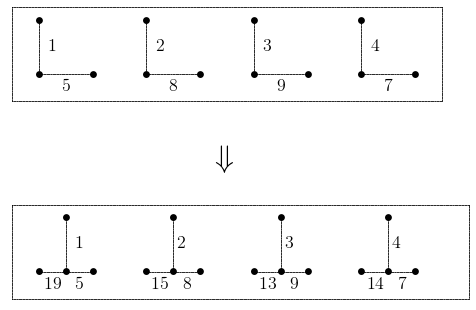
Example algorithm for fixing from is shown also in [1] (fig. 3)
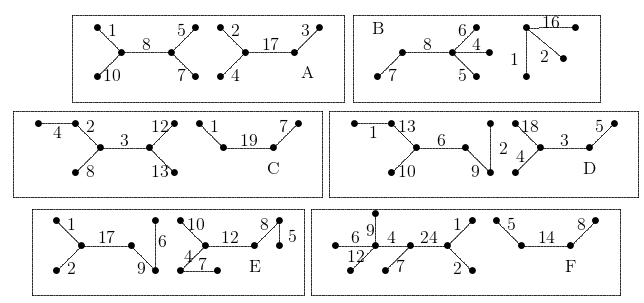
Finally special reference is done for forests with 2 components. The previous theorems help to rule out trivial cases for some number of vertices. In figure 4 there are all the perfect distance forests with two component for  ,
,

Refereces:
[1] B.Calhoun, J. Polhill, Perfect distance forests, Australian Journal of Combinatorics, vol. 42(2008), p. 211-222.
[2] W.Calhoun, K. Ferland, L. Lister and J. Polhill, Minimal distinct distance trees, J.Combin. Math. Combin. Computing vol. 61(2007) p. 33-57.


 and
and 
 zeracuse