dedicated to papis
Tag Archives: cfd
mesh competition
make your own grid and join Pointwise’s Meshy Award contest.
it’s another cool grid contest for CFD engineers :p
for more info here
Oil Leakage Through a Valve Stem Seal
The simulation of oil leakage through a valve stem seal involves complex fluid-structure interaction between a moving valve stem (rigid body), oil and deformable seal (flexible body). We can simulate the problem in a 3D model of a seal and considered a two-way fluid-structure coupling between the seal (structure) and oil (fluid).
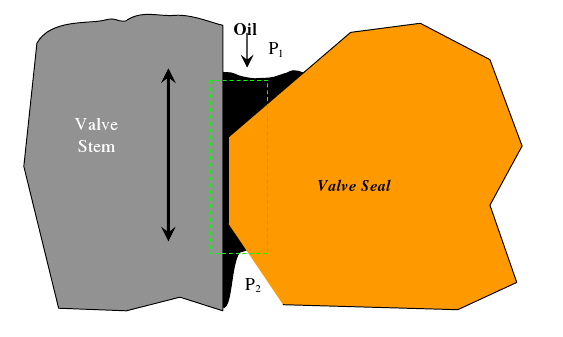
the physical problem –seal in operation
Governing equations
1) 
equals 
Navier-Stokes equations. Navier-Stokes equations in integral form applied to calculation grid of fluid flow domain are:

Numerical method – grid structure
Subgrid geometry resolution method.We can use rectangular FINITE-VOLUME grid with LOCAL ADAPTATION. The subgrid resolution is a Boolean operation between a Cartesian volume grid and curvilinear boundary defining the computational domain. The computational domain boundary is represented by a set of planar facets describing the valve stem and the valve seal. The valve seal is described by a volumetric finite element mesh. The valve seal boundary is formed by the outside faces of the finite elementsand provides a direct link between fluid grid and FE mesh .
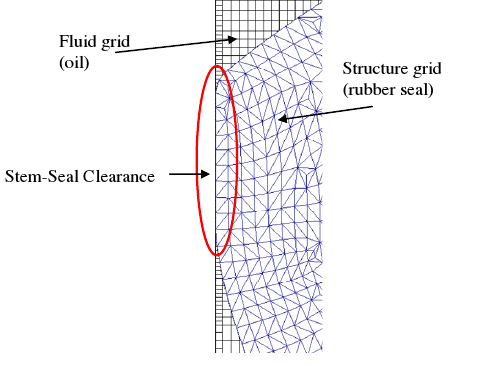
* I found this CFD problem at an ABACUS‘s users conference .
* for discretization scheme , and more details for the solution you can see deformablemesh-appliication-oilleak
* CFD methods provide calculations of the oil metering rate in channel formed by stemand deformed seal. But Finite Element Analysis or CFD techniques alone are unable to predict the amount of oil flow due to pressure changes between the top and bottom of the seal. Therefore the Fluid Structure Interaction (FSI) techniques is necessary to provide a comprehensive study the oil flow rate in the seal.
what is CFD ?
well a friend asked me what exactly is CFD or more formally Computational Fluid Mechanics and how does this field of engineering contributes in real life .
what is CFD ?
Computational Fluid Dynamics or CFD as it is popularly known, is used to generate flow simulations with the help of computers. CFD involves the solution of the governing laws of fluid dynamics numerically. The complex set of partial differential equations are solved on in geometrical domain divided into small volumes, commonly known as a mesh (or grid).
what is about ?
- CFD allows numerical simulation of fluid flows, results for which are available for study even after the anaylsis is over. This is a big advantage over, say, wind tunnel testing where analysts have a shorter duration to perform flow measurements.
- CFD allows observation of flow properties without disturbing the flow itself, which is not always possible with conventional measuring instruments.
- CFD allows observation of flow properties at locations which may not be accessible to (or harmful for) measuring instruments. For example, inside a combustion chamber, or between turbine blades.
- CFD can be used as a qualitative tool for discarding (or narrowing down the choices between), various designs. Designers and analysts can study prototypes numerically, and then test by experimentation only those which show promise.
CFD uses numerical methods to solve the fundamental nonlinear differential equations that describe fluid flow (the Navier-Stokes and allied equations) for predefined geometries and boundary conditions. The result is a wealth of predictions for flow velocity, temperature, density, and chemical concentrations for any region where flow occurs through virtual modeling techniques.
In the last decades computers improved CFD capabilities giving huge boost to Aeronautics , wind turbines modelling , aircraft design and more .
Remember one key-word above : mesh . The quality of the mesh plays huge role for solving NS-equations .
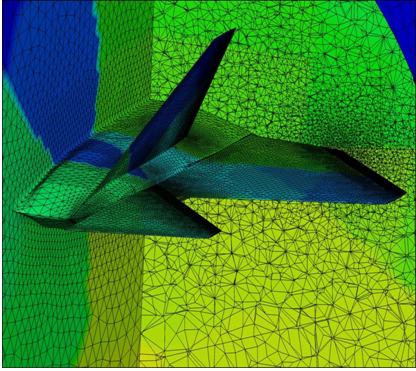
Large-Scale Numerical Simulations and Applications in CFD
Automatic triangulation of planar domain # cavendish algorithm
Let’s assume we want to construct a grid over an arbitrary planar domain filling it with triangles .We can use Cavendish’s semi automatic triangulation algorithm . This algorithm which will be described generates meshes with triangular elements for the decomposition of a region giving a special advantage to the user to specify the density of the elements , giving that way a mesh , appropriate to the physical and boundary conditions . The algorithm uses a modified algorithm from the Suhara-Fukuda algorithm and goes like this :
DEFINING THE AREA (interior , boundary nodes and density of elements)
For instance , let’s assume we want to generate a triangular mesh over a circular domain with circle in it ( hole) .We call the domain R. The user is first required to make an arcwise (multiply) .
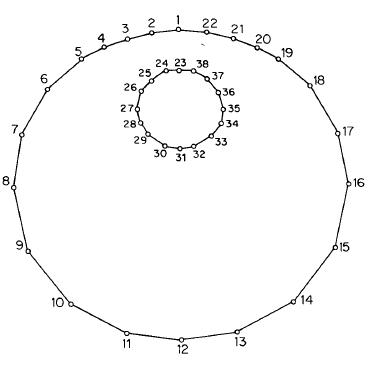
The domain R with counter-clockwise ordering of boundary nodes
connected polygonal approximation R to the planar structure to be triangulated.The boundary 
In order to provide the facility for triangulations of varying node density, the user is required to cover the region R with a disjoint set of simply connected polygonal zones 

For each zone there must be an accompanying density factor 


Zonal decomposition of R
In order to get triangles with very avute angles , we demand all the nodes to lie in the interior area that is defined by the boundary elements .
NODES GENERATING
Starting from node 1 and moving counter clockwise , the algorithm circumscribes the smallest rectangle in the zone Z which belongs .To make things clearer we superimpose a rectangular grid with unit equal to the density .Our purpose is to to randomly generate one interior node in each sub-square of the grid .

Generation of interior node points
Thus applying this to all the other sub-domains Zi we get the interior nodes . As many as five consecutive attempts are made to generate a retainable random point in any one sub-square. If no point is successfully generated after five consecutive attempts, then no node is designated in that sub-square and the next sub-square is considered. This process is repeated until all sub-squares have been tested .The flow chart of the method is the following :

But we are not done . there must be an algorithm that will precises the interconnections of the nodes by checking the neighborhood of each edge such that the choice of the 3rd node , will give as acute interior angels . But this will be discussed latter …
 zeracuse