New 17-million-digit monster is largest known prime !!!

The simulation of oil leakage through a valve stem seal involves complex fluid-structure interaction between a moving valve stem (rigid body), oil and deformable seal (flexible body). We can simulate the problem in a 3D model of a seal and considered a two-way fluid-structure coupling between the seal (structure) and oil (fluid).
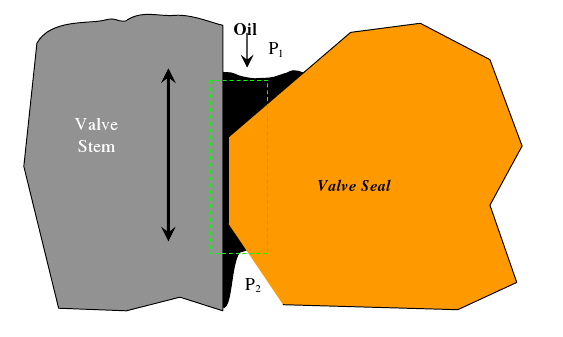
the physical problem –seal in operation
Governing equations
1) 
equals 
Navier-Stokes equations. Navier-Stokes equations in integral form applied to calculation grid of fluid flow domain are:
Numerical method – grid structure
Subgrid geometry resolution method.We can use rectangular FINITE-VOLUME grid with LOCAL ADAPTATION. The subgrid resolution is a Boolean operation between a Cartesian volume grid and curvilinear boundary defining the computational domain. The computational domain boundary is represented by a set of planar facets describing the valve stem and the valve seal. The valve seal is described by a volumetric finite element mesh. The valve seal boundary is formed by the outside faces of the finite elementsand provides a direct link between fluid grid and FE mesh .
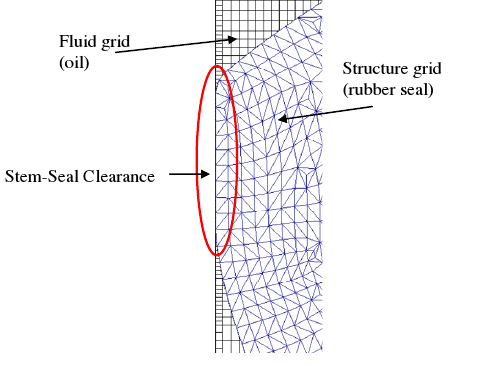
* I found this CFD problem at an ABACUS‘s users conference .
* for discretization scheme , and more details for the solution you can see deformablemesh-appliication-oilleak
* CFD methods provide calculations of the oil metering rate in channel formed by stemand deformed seal. But Finite Element Analysis or CFD techniques alone are unable to predict the amount of oil flow due to pressure changes between the top and bottom of the seal. Therefore the Fluid Structure Interaction (FSI) techniques is necessary to provide a comprehensive study the oil flow rate in the seal.
You can start with a graph which appear by default at GraphThing , like cycle , lattice , Petersen etc … or considering a single node , and start making your own graph adding nodes and edges . It ‘s quite easy to handle and has much fun .
You can download it at Ubuntu-software center for free .
The output can be GraphML format . GraphML is an xml-based file format for graphs. So in this case we will receive a file with xml code .I suggest to save the output as a postscript (file.ps) and then convert it at JPG , with the following command at the terminal :
gs -sDEVICE=jpeg -dJPEGQ=100 -dNOPAUSE -dBATCH -dSAFER -r300 -sOutputFile=file.jpg file.ps
this will probably give a jpg with width and height about 2000-3000 px , so just save it again , with a smaller amount of pixels .

 zeracuse