When the development of the jet engines started Russians engineers thought tried to adjust an extra security defensive system with missiles attached in the back area of the plane. If the plane was under attack the missiles where supposed to be fired at the enemies following. The results were surprisingly not so good though, since as tested the missiles almost instantly changed direction (rotating at turning against the plane itself and destroying it !!!
it looks like the blades of the missiles change its direction since the wind conforming vector has the same direction with the missiles velocity vector …
It is a high ridge in Antarctica on the East Antarctic Plateau where temperatures in several hollows can dip below minus 133.6 degrees Fahrenheit (minus 92 degrees Celsius) on a clear winter night — colder than the previous recorded low temperature (see the pic below).
Coldest place – East Antarctic Plateau
. Scientists at the National Snow and Ice Data Center made the discovery while analyzing the most detailed global surface temperature maps to date, developed with data from remote sensing satellites including the MODIS sensor on NASA’s Aqua satellite, and the TIRS sensor on Landsat 8, a joint project of NASA and the U.S. Geological Survey (USGS).
Explanation of the phenomenon
It’s has to do with Solar radiation mechanisms and heat transfer in such extreme environmental conditions. A portion of the solar radiation is absorbed, and the rest is reflected. The portion reflected (called the albedo) is affected by precipitation and ablation, because fresh snow is more reflective than old snow or ablating ice. The dry air radiates awy solar radiation.
This article from MIT might explain why the two fields of study are more alike than different.
When fluid dynamics mimic quantum mechanics
MIT researchers expand the range of quantum behaviors that can be replicated in fluidic systems, offering a new perspective on wave-particle duality.
In the early days of quantum physics, in an attempt to explain the wavelike behavior of quantum particles, the French physicist Louis de Broglie proposed what he called a “pilot wave” theory. According to de Broglie, moving particles — such as electrons, or the photons in a beam of light — are borne along on waves of some type, like driftwood on a tide.
Several years ago a fluid system was shown to reproduce the classic “double slit” experiment from physics. Now researchers from MIT have reproduced another phenomena from physics – the statistical behavior of electrons when confined in a circular region by ions. The experiment involves bouncing a droplet on the vibrating surface of a fluid and monitoring its path as it moves around the surface. The video at the link explains everything.
This might be startling or a manifestation of particle-wave duality.
Read this article above or watch the experiment here:
The following experiment about the thermally stressed layer of a binary liquid mixture. Recently, researchers were exploring this problem—with the added twist of tilting the fluids a few milliradians when they discovered a surprising result. After an extended time, the convection self-organized into alternating parallel columns of ascending (dark) and descending (light) fluid. The researchers nicknamed this behavior super-highway convection.
Define continuing forever motions … :
Perpetual motion describes “motion that continues indefinitely without any external source of energy; impossible in practice because of friction. It can also be described as “the motion of a hypothetical machine which, once activated, would run forever unless subject to an external force or to wear”.
Cases of apparent perpetual motion can exist in nature, but either are not truly perpetual or cannot be used to do work without changing the nature of the motion. For example, the motion of a planet around its star may appear “perpetual,” but interplanetary space is not completely frictionless, so planets’ orbital motion is very gradually slowed over time.
Basic principles:
1. In any isolated system, one cannot create new energy (first law of thermodynamics)
2. The output power of heat engines is always smaller than the input heating power. The rest of the energy is removed as heat at ambient temperature. The efficiency (this is the produced power divided by the input heating power) has a maximum, given by the Carnot efficiency. It is always lower than one
3. The efficiency of real heat engines is even lower than the Carnot efficiency due to irreversible processes.
The statements 2 and 3 only apply to heat engines. Other types of engines, which convert e.g. mechanical into electromagnetic energy, can, in principle, operate with 100% efficiency.
Classification
One classification of perpetual motion machines refers to the particular law of thermodynamics the machines purport to violate:
a) A perpetual motion machine of the first kind produces work without the input of energy. It thus violates the first law of thermodynamics: the law of conservation of energy.
b) A perpetual motion machine of the second kind is a machine which spontaneously converts thermal energy into mechanical work. When the thermal energy is equivalent to the work done, this does not violate the law of conservation of energy. However it does violate the more subtle second law of thermodynamics (see also entropy). The signature of a perpetual motion machine of the second kind is that there is only one heat reservoir involved, which is being spontaneously cooled without involving a transfer of heat to a cooler reservoir. This conversion of heat into useful work, without any side effect, is impossible, according to the second law of thermodynamics.
A more obscure category is a perpetual motion machine of the third kind, usually (but not always)[5] defined as one that completely eliminates friction and other dissipative forces, to maintain motion forever (due to its mass inertia). Third in this case refers solely to the position in the above classification scheme, not the third law of thermodynamics. Although it is impossible to make such a machine,[6][7] as dissipation can never be 100% eliminated in a mechanical system, it is nevertheless possible to get very close to this ideal (see examples in the Low Friction section). Such a machine would not serve as a source of energy but would have utility as a perpetual energy storage device.
Epistemic possibility of perpetual motions
Epistemic possibility describes things which absolutely cannot occur within our current formulation of the physical laws. This interpretation of the word “impossible” is what is intended in discussions of the impossibility of perpetual motion in a closed system. The conservation laws are particularly robust from a mathematical perspective. Noether’s theorem, which was proven mathematically in 1915, states that any conservation law can be derived from a corresponding continuous symmetry of the action of a physical system.For example, if the true laws of physics remain invariant over time then the conservation of energy follows. On the other hand, if the conservation laws are invalid, then the foundations of physics would need to change.
Scientific investigations as to whether the laws of physics are invariant over time use telescopes to examine the universe in the distant past to discover, to the limits of our measurements, whether ancient stars were identical to stars today. Combining different measurements such as spectroscopy, direct measurement of the speed of light in the past and similar measurements demonstrates that physics has remained substantially the same, if not identical, for all of observable history spanning billions of years.
The principles of thermodynamics are so well established, both theoretically and experimentally, that proposals for perpetual motion machines are universally met with disbelief on the part of physicists. Any proposed perpetual motion design offers a potentially instructive challenge to physicists: one is almost completely certain that it cannot work, so one must explain how it fails to work. The difficulty (and the value) of such an exercise depends on the subtlety of the proposal; the best ones tend to arise from physicists’ own thought experiments and often shed light upon certain aspects of physics. So, for example, the thought experiment of a Brownian ratchet as a perpetual motion machine was first discussed by Gabriel Lippmann in 1900 but it was not until 1912 that Marian Smoluchowski gave an adequate explanation for why it cannot work. However, during that twelve-year period scientists did not believe that the machine was possible. They were merely unaware of the exact mechanism by which it would inevitably fail.
Motionless electromagnetic generator circuit as explained in US Patent
Apparent perpetual motion machines
Even though they fully respect the laws of thermodynamics, there are a few conceptual or real devices that appear to be in “perpetual motion.” Closer analysis reveals that they actually “consume” some sort of natural resource or latent energy, such as the phase changes of water or other fluids or small natural temperature gradients. In general, extracting large amounts of work using these devices is difficult to impossible.
Scientists have known for generations that hot water can sometimes freeze faster than cold, an effect known as the Mpemba effect, but until now have not understood why. Several theories have been proposed , but none has been accepted as the ‘formal’ solution of the problem .
Theories for the Mpemba effect have included:
– faster evaporation of hot water, which reduces the volume left to freeze
– formation of a frost layer on cold water, insulating it
– different concentrations of solutes such as carbon dioxide, which is driven off when the water is heated .
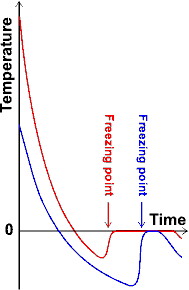
– supercooling that cold water, when placed in a freezing environment, supercools more than hot water in the same environment, thus solidifying slower than hot water .
– impurities in the water that seed ice crystal formation , effecting the freezing point
The problem is that the effect does not always appear, and cold water often freezes faster than hot water.
it’s really interesting that this problem holds some decades , where in the mean while we found new chemical elements , built new mars research centers , we have higgs boson under ”surveillance” ….
For more info you can check at wikipedia with much more details here , and can download and read a nice paper from James D. Brownridge in here .


 zeracuse