MESH REFINEMENT:
– description
– development
– test cases
– results
After deciding the criterion of the refinement eg the mean error of energy ,for subsonic flow at 


And the pressure coefficient is the following graph (this is not troll :p)

dedicated to all my fellows at ntua (papis,dimitris J.,dimitris,aris,kostas).
it’s official for Wikipedia : divide and conquer algorithms are the faster for Delaunay triangulation ,so to celebrate let’s talk about this specific algorithm for the triangulation of a set of points (2D or 3D) which is called grid and is used in many aspects of scientific computing.
DELAUNΑY TRIANGULATION
DT combines several quality measures : maxmin angle condition,minmax constrained circumcenter etc .DT of a point set is the planar dual of the Voronoi diagram.The Voronoi Diagram is a partition of the plane into polygonal cells, each of one assinged to an initial point., so that the cell for input point P consists of a region fo the plane closer to P than any other input point.Any point (nodal-point of the grid) lies outside the circumcentre and hence any vertex of the Voronoi diagram has degree 3 and the DT will be a triangulation.
There are many algorythms for DT.Some of them have to do with the Convex hull of the set points.The main idea goes like this : Lift each point of the input to a paraboloid in one dimension up (for 2D it will be 3D) ,by mapping the point 


Many algorythms of 
SOURCE CODE
you can try to compute the delauney triangulation from source code for your input data points from here (Fortran 90,C,C++)
well a friend asked me what exactly is CFD or more formally Computational Fluid Mechanics and how does this field of engineering contributes in real life .
what is CFD ?
Computational Fluid Dynamics or CFD as it is popularly known, is used to generate flow simulations with the help of computers. CFD involves the solution of the governing laws of fluid dynamics numerically. The complex set of partial differential equations are solved on in geometrical domain divided into small volumes, commonly known as a mesh (or grid).
what is about ?
CFD uses numerical methods to solve the fundamental nonlinear differential equations that describe fluid flow (the Navier-Stokes and allied equations) for predefined geometries and boundary conditions. The result is a wealth of predictions for flow velocity, temperature, density, and chemical concentrations for any region where flow occurs through virtual modeling techniques.
In the last decades computers improved CFD capabilities giving huge boost to Aeronautics , wind turbines modelling , aircraft design and more .
Remember one key-word above : mesh . The quality of the mesh plays huge role for solving NS-equations .
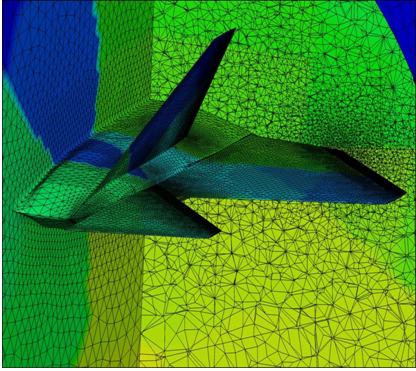
Large-Scale Numerical Simulations and Applications in CFD
Mesh generation has been an important procedure in computational fluid dynamics (CFD) modeling. A good mesh should be able to :
For these reasons, adaptive methods in CFD have receivved much attention over the past thirty years due to their flexibility in resolving complex geometries and other problems such as unsteadyvv flow calculations. The goal of these methods is to evenly distribute error over the whole flow domain in order to minimize global inaccuracvy.
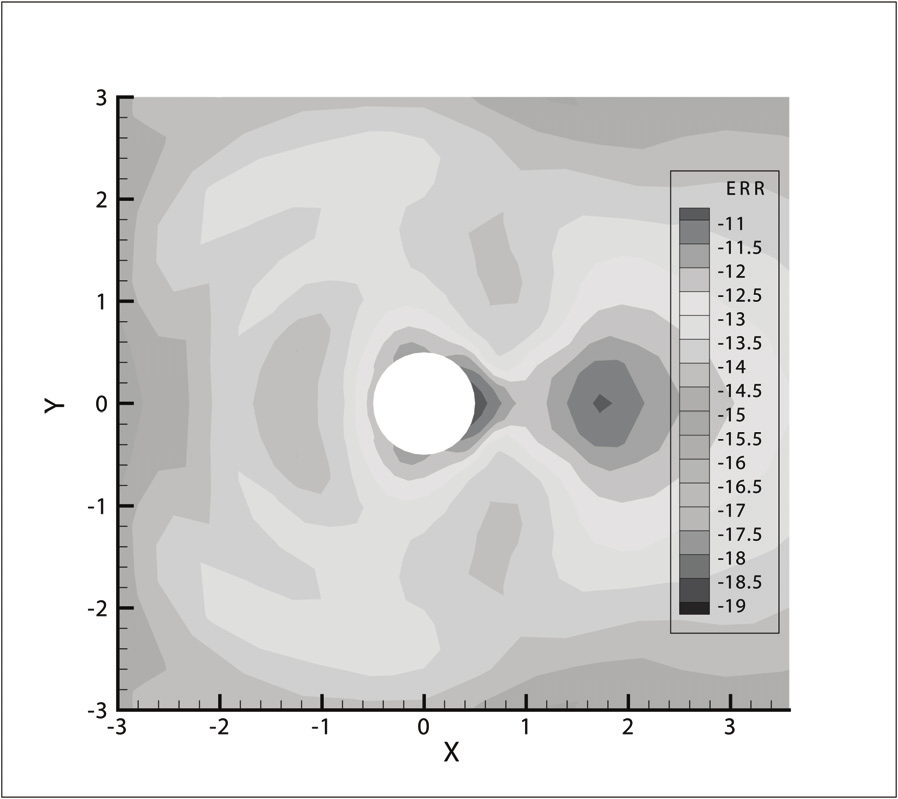
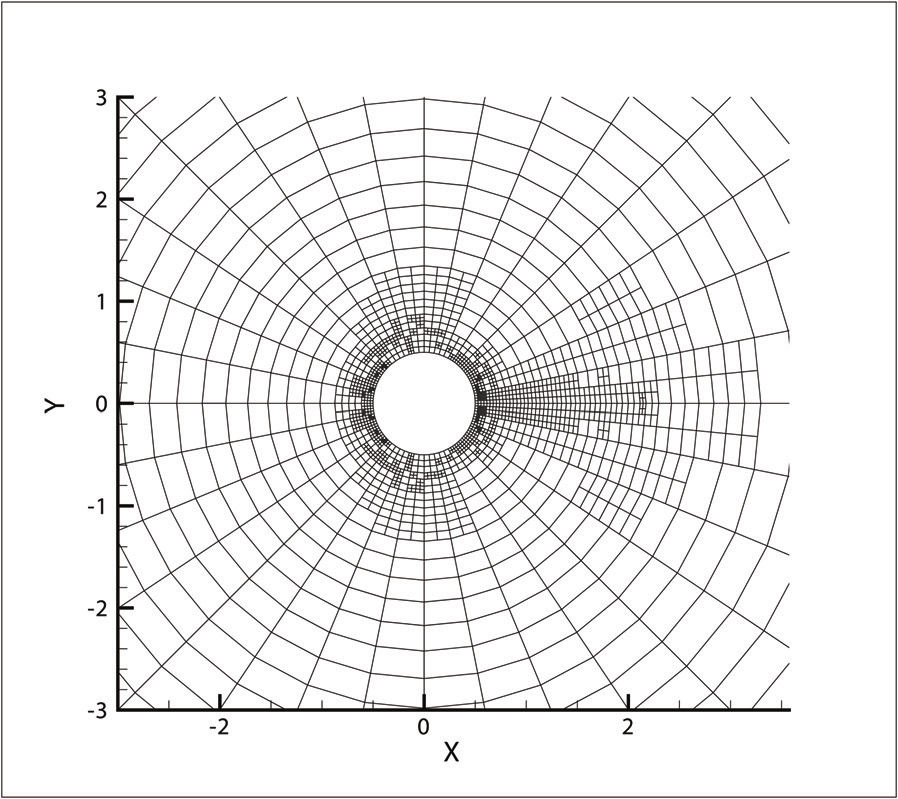
The adaptation is usually based on some error indicav tors calculated from solutions given in the past iterations, so that regions with larger errors are refined (and in some cases, those with l ess errors coarsened). So using either h-,p-,hp-refinement we can achieve the optimal grid .For example for a cylinder , considering the error , upwind and downwind , we apply there finement at the area which is required , which is past the cylinder where vortices exist .
Below appear : on the left the error distribution and on the right the refined grid after 3 h-refinements (STRUCTURED GRID)
this could be applied for an UNSTRUCTRED GRID like the following ( note that this is not refined, it’s a “coarse grid”)

or apply a refinement at HYBRID grid

Let’s assume we want to construct a grid over an arbitrary planar domain filling it with triangles .We can use Cavendish’s semi automatic triangulation algorithm . This algorithm which will be described generates meshes with triangular elements for the decomposition of a region giving a special advantage to the user to specify the density of the elements , giving that way a mesh , appropriate to the physical and boundary conditions . The algorithm uses a modified algorithm from the Suhara-Fukuda algorithm and goes like this :
DEFINING THE AREA (interior , boundary nodes and density of elements)
For instance , let’s assume we want to generate a triangular mesh over a circular domain with circle in it ( hole) .We call the domain R. The user is first required to make an arcwise (multiply) .
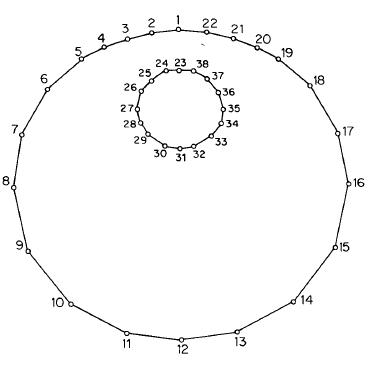
The domain R with counter-clockwise ordering of boundary nodes
connected polygonal approximation R to the planar structure to be triangulated.The boundary 
In order to provide the facility for triangulations of varying node density, the user is required to cover the region R with a disjoint set of simply connected polygonal zones 

For each zone there must be an accompanying density factor 

Zonal decomposition of R
In order to get triangles with very avute angles , we demand all the nodes to lie in the interior area that is defined by the boundary elements .
NODES GENERATING
Starting from node 1 and moving counter clockwise , the algorithm circumscribes the smallest rectangle in the zone Z which belongs .To make things clearer we superimpose a rectangular grid with unit equal to the density .Our purpose is to to randomly generate one interior node in each sub-square of the grid .

Generation of interior node points
Thus applying this to all the other sub-domains Zi we get the interior nodes . As many as five consecutive attempts are made to generate a retainable random point in any one sub-square. If no point is successfully generated after five consecutive attempts, then no node is designated in that sub-square and the next sub-square is considered. This process is repeated until all sub-squares have been tested .The flow chart of the method is the following :

But we are not done . there must be an algorithm that will precises the interconnections of the nodes by checking the neighborhood of each edge such that the choice of the 3rd node , will give as acute interior angels . But this will be discussed latter …

 zeracuse