The simulation of oil leakage through a valve stem seal involves complex fluid-structure interaction between a moving valve stem (rigid body), oil and deformable seal (flexible body). We can simulate the problem in a 3D model of a seal and considered a two-way fluid-structure coupling between the seal (structure) and oil (fluid).
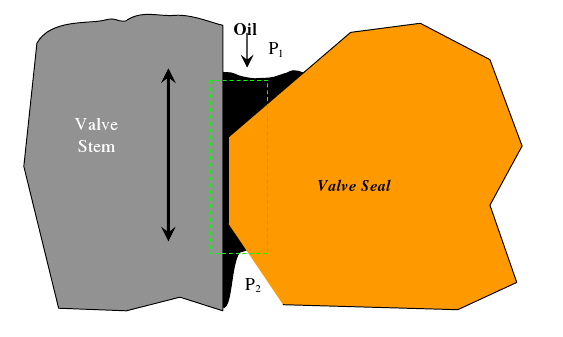
the physical problem –seal in operation
Governing equations
1) 
equals 
Navier-Stokes equations. Navier-Stokes equations in integral form applied to calculation grid of fluid flow domain are:

Numerical method – grid structure
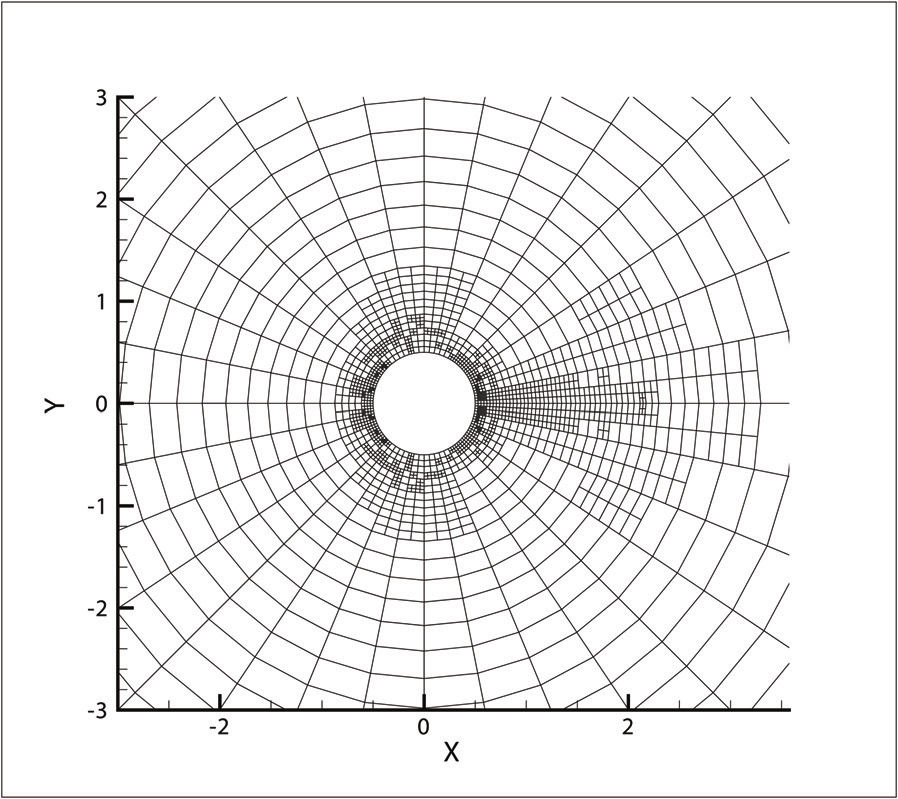
Subgrid geometry resolution method.We can use rectangular FINITE-VOLUME grid with LOCAL ADAPTATION. The subgrid resolution is a Boolean operation between a Cartesian volume grid and curvilinear boundary defining the computational domain. The computational domain boundary is represented by a set of planar facets describing the valve stem and the valve seal. The valve seal is described by a volumetric finite element mesh. The valve seal boundary is formed by the outside faces of the finite elementsand provides a direct link between fluid grid and FE mesh .
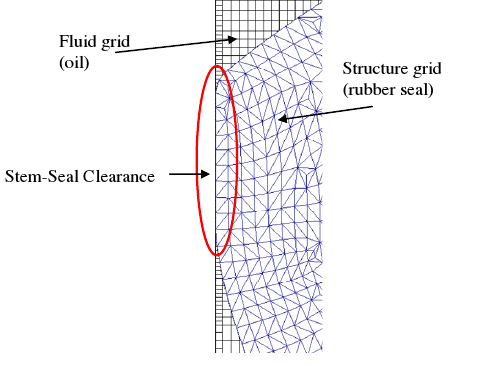
* I found this CFD problem at an ABACUS‘s users conference .
* for discretization scheme , and more details for the solution you can see deformablemesh-appliication-oilleak
* CFD methods provide calculations of the oil metering rate in channel formed by stemand deformed seal. But Finite Element Analysis or CFD techniques alone are unable to predict the amount of oil flow due to pressure changes between the top and bottom of the seal. Therefore the Fluid Structure Interaction (FSI) techniques is necessary to provide a comprehensive study the oil flow rate in the seal.
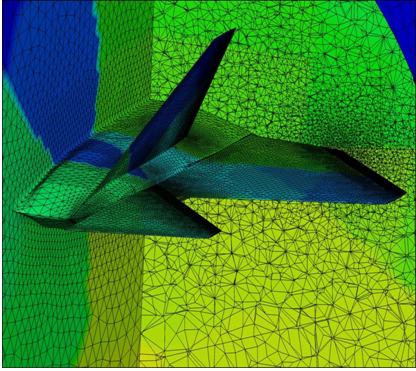


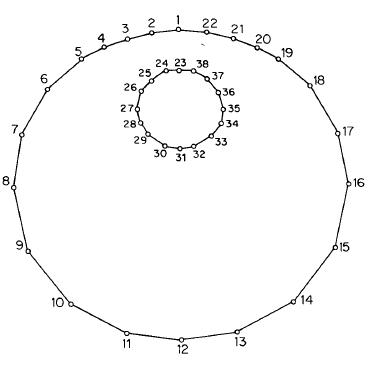
 must be composed of a disjoint union of simple, closed, piecewise linear arcs.
 ,
, In particular, for each zone
 > 0.
> 0.


 zeracuse
