well a friend asked me what exactly is CFD or more formally Computational Fluid Mechanics and how does this field of engineering contributes in real life .
what is CFD ?
Computational Fluid Dynamics or CFD as it is popularly known, is used to generate flow simulations with the help of computers. CFD involves the solution of the governing laws of fluid dynamics numerically. The complex set of partial differential equations are solved on in geometrical domain divided into small volumes, commonly known as a mesh (or grid).
what is about ?
- CFD allows numerical simulation of fluid flows, results for which are available for study even after the anaylsis is over. This is a big advantage over, say, wind tunnel testing where analysts have a shorter duration to perform flow measurements.
- CFD allows observation of flow properties without disturbing the flow itself, which is not always possible with conventional measuring instruments.
- CFD allows observation of flow properties at locations which may not be accessible to (or harmful for) measuring instruments. For example, inside a combustion chamber, or between turbine blades.
- CFD can be used as a qualitative tool for discarding (or narrowing down the choices between), various designs. Designers and analysts can study prototypes numerically, and then test by experimentation only those which show promise.
CFD uses numerical methods to solve the fundamental nonlinear differential equations that describe fluid flow (the Navier-Stokes and allied equations) for predefined geometries and boundary conditions. The result is a wealth of predictions for flow velocity, temperature, density, and chemical concentrations for any region where flow occurs through virtual modeling techniques.
In the last decades computers improved CFD capabilities giving huge boost to Aeronautics , wind turbines modelling , aircraft design and more .
Remember one key-word above : mesh . The quality of the mesh plays huge role for solving NS-equations .
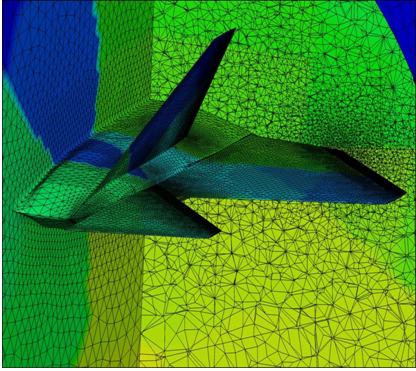
Large-Scale Numerical Simulations and Applications in CFD

 zeracuse