Scientists have known for generations that hot water can sometimes freeze faster than cold, an effect known as the Mpemba effect, but until now have not understood why. Several theories have been proposed , but none has been accepted as the ‘formal’ solution of the problem .
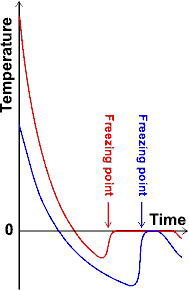
Theories for the Mpemba effect have included:
– faster evaporation of hot water, which reduces the volume left to freeze
– formation of a frost layer on cold water, insulating it
– different concentrations of solutes such as carbon dioxide, which is driven off when the water is heated .
– supercooling that cold water, when placed in a freezing environment, supercools more than hot water in the same environment, thus solidifying slower than hot water .
– impurities in the water that seed ice crystal formation , effecting the freezing point
The problem is that the effect does not always appear, and cold water often freezes faster than hot water.
it’s really interesting that this problem holds some decades , where in the mean while we found new chemical elements , built new mars research centers , we have higgs boson under ”surveillance” ….

 zeracuse