Mesh generation has been an important procedure in computational fluid dynamics (CFD) modeling. A good mesh should be able to :
- capture as many details as possible in the flow
- not overly resolved in the regions with mostly uniform flow.As a result one can achieve optimal accuracy in the solution with minimal computational cost. In order to generate such a mesh, a lot of prior knowledge about the pvv hysics of the modeled problem as well as the assumptions and limitations of the computational scheme is needed. Sometimes the time and cost invested in mesh generation can take up a large percentage of the total modeling effort. Even so, when we encount er complex structural geometries or flows with a wide range of length scales, it is very hard to produce a mesh that is ‘optimal’.vv
For these reasons, adaptive methods in CFD have receivved much attention over the past thirty years due to their flexibility in resolving complex geometries and other problems such as unsteadyvv flow calculations. The goal of these methods is to evenly distribute error over the whole flow domain in order to minimize global inaccuracvy.
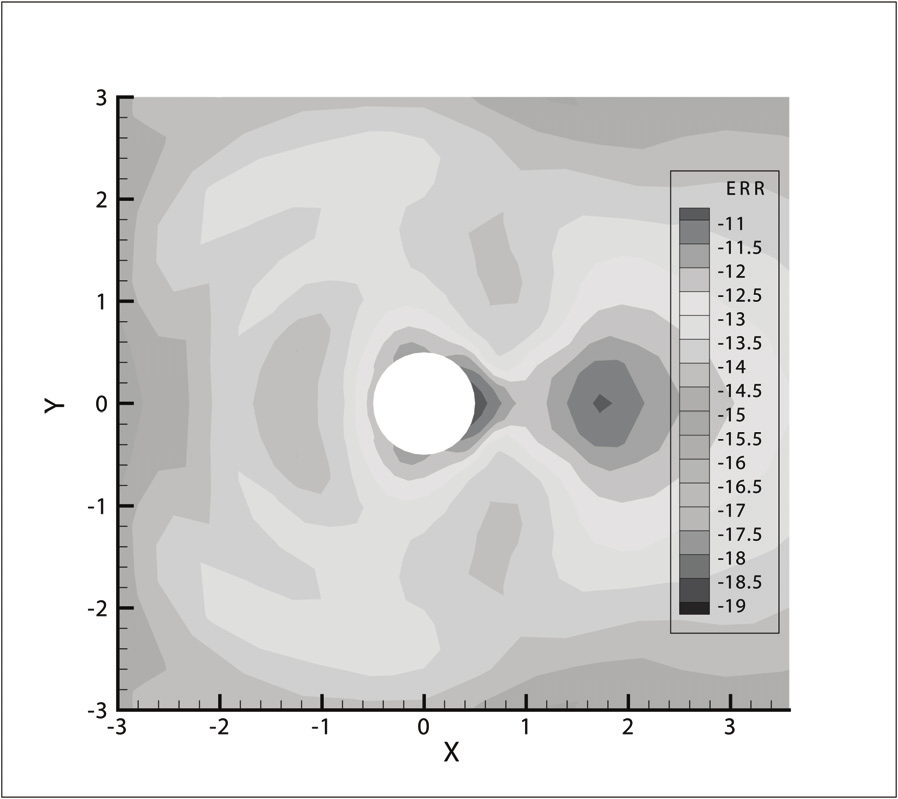
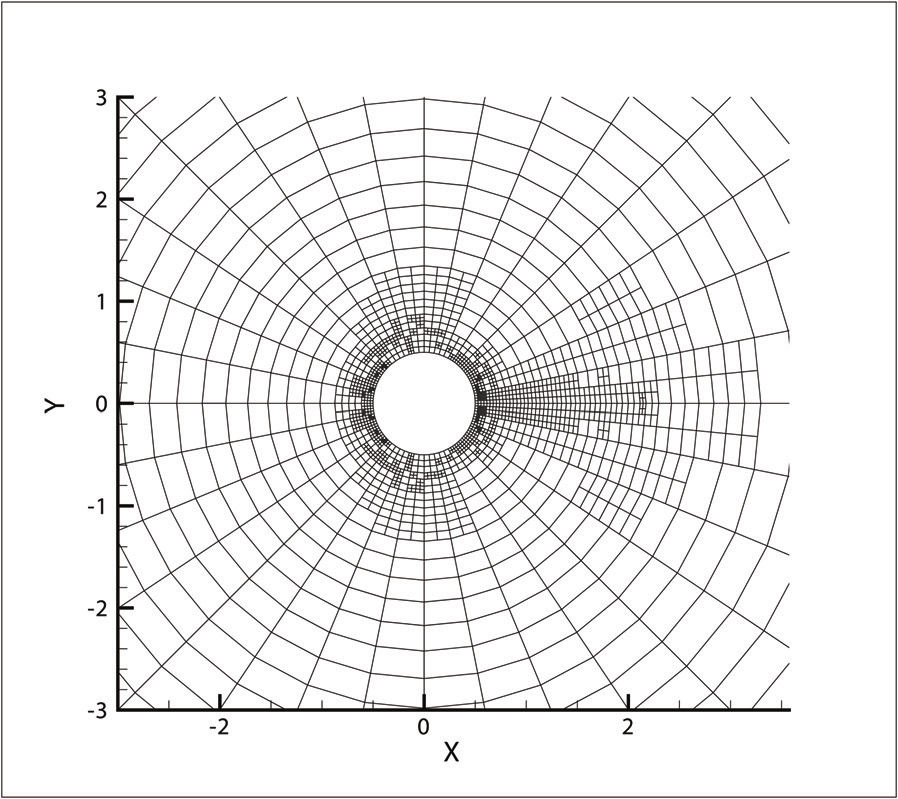
The adaptation is usually based on some error indicav tors calculated from solutions given in the past iterations, so that regions with larger errors are refined (and in some cases, those with l ess errors coarsened). So using either h-,p-,hp-refinement we can achieve the optimal grid .For example for a cylinder , considering the error , upwind and downwind , we apply there finement at the area which is required , which is past the cylinder where vortices exist .
Below appear : on the left the error distribution and on the right the refined grid after 3 h-refinements (STRUCTURED GRID)
this could be applied for an UNSTRUCTRED GRID like the following ( note that this is not refined, it’s a “coarse grid”)

or apply a refinement at HYBRID grid


 zeracuse